Majnesvon Inflatable Paddle Boards for Real Water Days
These two extra-wide inflatable SUPs are designed for casual paddlers who want a stable, high-capacity board that sets up fast and packs down small. Both carry up to 400 lbs, come with an adjustable dual-use paddle, and work for everyone from first-timers to families sharing a board on a flat lake. If you're looking for a touring board or something for choppy ocean water, these aren't it — but for calm lakes, slow rivers, and weekend use, they're built for exactly that.

Both Boards, Side by Side
Extra Wide SUP 400lb (Blue)
See on Amazon
Extra Wide SUP 400lb (Blue Alt)
See on AmazonSee more products
Discover the full product lineup with current selection on Amazon.
All products on AmazonBoard Specs at a Glance
Here's a direct comparison of the two Majnesvon inflatable paddle boards based on the specs provided — useful for making the final call between them.
| Model | Dimensions (L × W × Thickness) | Weight Capacity | Fins | What's Included | Best For |
|---|---|---|---|---|---|
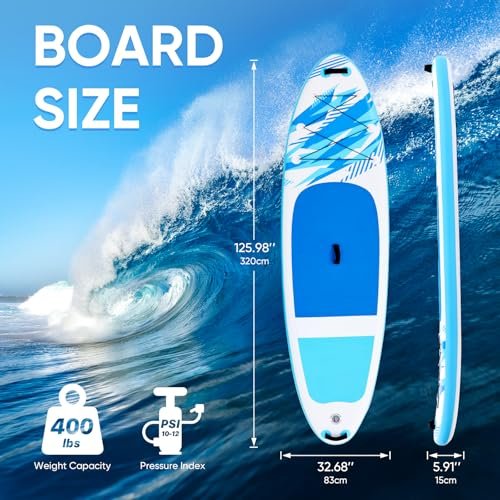
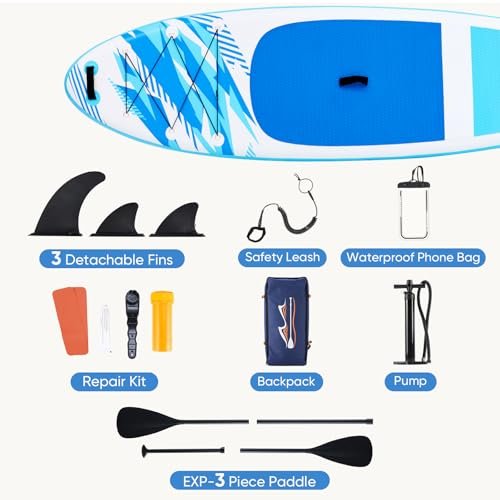
| Extra Wide SUP — B0FC2KL863 (Blue) | 125.98 × 32.68 × 0.1 in | 400 lbs | 3 detachable fins | Adjustable dual-use paddle, pump, repair kit, backpack | Paddlers who want multiple fin configs and a complete carry kit in one package |
| Extra Wide SUP — B0FHJSFBFR (Blue) | 132 × 33 × 0.1 in | 400 lbs | Removable single fin | Adjustable dual-use paddle, repair kit, ankle leash, phone case, waterproof bag, hand pump, wrench | Paddlers who want a longer glide and need safety/accessory gear (leash, phone case) included |
If you're choosing based purely on use, go with the B0FC2KL863 for a more maneuverable platform with multiple fin options; choose the B0FHJSFBFR if the additional six inches of length matters for tracking and you want the leash and phone case included without buying them separately.
What to Look At Before You Pick One
The two Majnesvon boards are close in design, but there are a few real differences worth understanding before you choose. The B0FHJSFBFR model is slightly longer (132 inches vs. 125.98 inches) and slightly wider (33 inches vs. 32.68 inches). Those numbers sound small, but an extra six inches of length affects how the board glides on flat water — a longer waterline tracks more efficiently, meaning less correction paddling to keep a straight line. The width difference is minor enough that both boards offer comparable lateral stability.
The bigger difference is what's in the box. The B0FC2KL863 model includes a pump and a repair kit, plus a backpack and three detachable fins. The B0FHJSFBFR model lists a removable fin, ankle leash, phone case, waterproof bag, hand pump, and wrench — a different accessory package, not necessarily a better or worse one. Think about which accessories you'd actually use. If you're planning to paddle with a phone or need a leash for safety, the second model's kit covers that out of the box. If you want multiple fin configurations, the three detachable fins on the first model give you more setup options for different water conditions.
- Length: The 132-inch board gives you a slightly longer glide stroke and marginally better straight-line tracking. The 125.98-inch board is a bit more maneuverable — better for paddlers who want to turn easily or share a session with a kid on board.
- Fin setup: Three detachable fins (B0FC2KL863) let you configure for stability or tracking depending on conditions. The removable single fin (B0FHJSFBFR) is simpler — fine for flat calm water, less adjustable for anything more variable.
- Included accessories: Match the kit to what you'll actually need. If an ankle leash, phone case, and waterproof bag matter to you, the B0FHJSFBFR package covers them. If the repair kit and backpack are your priority, the B0FC2KL863 checks those.
- Weight capacity: Both boards are rated to 400 lbs. That's a meaningful spec — it accommodates a heavier adult solo, or an adult plus a small child, without being right at the edge of the limit.
Who These Boards Are Actually Built For
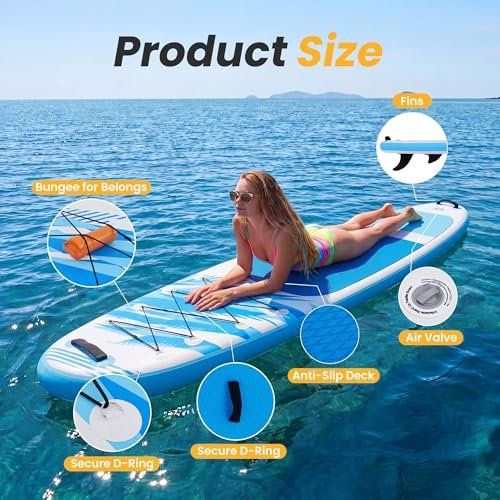
Both Majnesvon boards are listed as suitable for all skill levels, and that's accurate in a specific sense: they're stable enough that a first-timer isn't going to spend the whole session falling off. At 32–33 inches wide, these are extra-wide boards — most standard all-around SUPs come in at 30–32 inches. That added width makes a real difference for people who are heavier, less confident about balance, or paddling with a young child sitting in front of them. It's not a performance trade-off you'll notice much on flat water.
The honest use case for these boards is a calm lake or slow-moving river on a weekend. They're not built for ocean swells, whitewater, or distance touring. If you're paddling on flatwater with family, bringing a dog along, or just want to float around for an hour without needing a lesson first, these work well for that. If you already have a season or two of SUP experience and want a board that tracks well at speed, or if you're paddling in anything other than calm conditions, look at a stiffer performance board with a higher PSI range and a displacement hull.
- First-time paddlers: Both boards' extra width and 400 lb capacity give you the margin to find your balance without feeling like the board is constantly trying to tip you.
- Heavier riders: The 400 lb rating means a 250 lb adult isn't right at the edge of the limit — there's real headroom in the capacity spec.
- Families with young kids: A child can sit or kneel at the front while an adult paddles. The extra-wide platform gives enough room for that without destabilizing the board.
- Casual lake and river users: These boards are built around flat, calm water. If that's your scenario most weekends, the boards perform right in their intended use case.
Setup, Inflation, and Keeping It in Shape
Inflatable SUPs live and die by how well you inflate them and how you store them afterward. Both Majnesvon boards include a hand pump — the dual-action type gets you to working pressure faster than a single-action pump because it pushes air on both the down and up stroke. For most all-around inflatable boards, target pressure is in the 12–15 PSI range. Under-inflating is the most common beginner mistake: a board at 8 PSI will feel soft and unstable underfoot, which is what gives inflatable SUPs a bad reputation. Inflate to at least 12 PSI and you'll feel a meaningfully stiffer, more responsive platform.
After each session, rinse the board with fresh water if you've been on salt water or a lake with algae. Deflate it completely before rolling it up for storage — storing it partially inflated stresses the seams over time. Both boards come with a repair kit, which matters because small punctures from debris happen. The repair process is straightforward: dry the area, rough it up slightly, apply the patch from the kit, and let it cure before re-inflating. Don't store a wet board rolled up in its bag — moisture trapped inside the roll creates the conditions for mold and seam degradation.
- Inflation target: 12–15 PSI. Anything under 12 PSI and you'll feel the board flex underfoot — not dangerous on flat water, but noticeably less stable and harder to paddle in a straight line.
- Pump type: Both models include a hand pump. If you're inflating regularly or have a larger group, an electric pump (sold separately) speeds up the process significantly — hand pumping to 15 PSI takes effort.
- Fin care: Detachable fins (B0FC2KL863) should be removed before rolling the board for storage. Leaving fins attached stresses the fin boxes and can cause cracking at the attachment point over repeated storage cycles.
- Storage: Deflated, rolled, and dry. Both boards pack into a backpack-style bag (included with B0FC2KL863; confirm for the second model). Don't leave the board inflated in direct sunlight for extended periods — heat causes pressure buildup that stresses the PVC.
- Repair kit: Keep it with the board, not in a separate drawer. Small punctures are common enough that you want the kit accessible at the launch site.
Frequently Asked Questions
Can two people ride one of these boards at the same time?
Technically, the 400 lb capacity could accommodate two adults depending on combined weight — but both boards are designed and listed as single-rider SUPs. Two adults standing on a 32–33 inch wide board is tight and makes paddling awkward. A more realistic "two person" setup is one adult paddling while a young child sits or kneels at the nose. For that use case, either board has the capacity and platform size to handle it comfortably on flat water.
What PSI should I inflate these boards to?
Target 12–15 PSI for flat-water use. The boards include a hand pump — inflate until the board feels firm underfoot with no flex when you press down in the center. If you're a heavier rider (over 200 lbs), inflating toward the higher end of that range (14–15 PSI) will give you a noticeably stiffer, more stable platform. Under-inflation is the most common reason beginners find an inflatable board feels wobbly.
Do these boards work for beginners with no SUP experience?
Yes, for calm flat water. The extra-wide platform (32–33 inches) is wider than most entry-level SUPs, which makes it more forgiving when you're still figuring out your balance. Neither board is going to teach itself — you'll still need to find your stance and get comfortable with the paddle — but the width gives you margin that a narrower board doesn't. If you're planning to paddle in anything other than calm conditions, take a lesson first regardless of board width.
What's the difference between the three-fin setup and the single removable fin?
The three-fin setup on the B0FC2KL863 gives you more tracking stability — the center fin handles straight-line direction while the two side fins reduce side-to-side drift. It's the more versatile configuration for varied flatwater conditions. The single removable fin on the B0FHJSFBFR is simpler: it does the job on calm water and is easier to manage when you're packing up quickly. Neither setup is better in an absolute sense — the three-fin board suits paddlers who want more control; the single-fin board suits paddlers who want simplicity.
Do these boards come with everything I need to get on the water, or do I need to buy extra gear?
Both boards include an adjustable dual-use paddle and a hand pump, so you can get on the water without buying additional gear. The B0FC2KL863 also includes a repair kit and a backpack carry bag. The B0FHJSFBFR adds an ankle leash, phone case, waterproof bag, and wrench. Neither board lists a life jacket as included — that's a separate purchase and legally required on most US waterways for non-swimmers and children under a certain age depending on your state. Check your local regulations before your first session.
Are these boards suitable for ocean use or whitewater?
No. Both boards are designed for flat, calm water — lakes, slow-moving rivers, calm bays. Ocean surf introduces swells and chop that an extra-wide flatwater board isn't shaped to handle well; you'd spend the session fighting the water rather than paddling. Whitewater is a completely different category and neither board is built for it. If your paddling location involves anything other than calm flatwater, look at a purpose-built board with a displacement nose and a stiffer construction spec.